Quality

Quality control and laboratory testing

PakTalc talc is checked at three points: by eye during hand sorting at the mine, by grade segregation in the Peshawar yard, and by laboratory analysis of powder samples at SKZ Laboratory Peshawar. Buyers can ask for a lot-specific analysis with their quotation.

Laboratory technician in a white coat operating an analytical instrument connected to a computer.

Checkpoints

Where talc is checked

Quality comes from selection as much as from testing. These are the checkpoints between the face and the container.

  1. White talc fragments with a geological hammer resting on top at a field site.

    01 Mine

    Selection at the face

    • White talc kept apart from waste rock during extraction
    • Field samples taken during survey work
  2. Two inspectors in uniforms and caps checking white talc lumps with a worker during hand sorting.

    02 Mine yard

    Hand sorting & inspection

    • Foreign rock removed by hand
    • Lumps separated by colour grade and size
    • Sorted piles checked by inspectors before bagging
  3. Two men standing in a yard of white talc lump stockpiles.

    03 Peshawar yard

    Grade segregation

    • Stockpiles kept separate by source and colour
    • Material allocated to orders by grade
  4. Laboratory technician in a white coat operating an analytical instrument connected to a computer.

    04 SKZ Laboratory Peshawar

    Laboratory analysis

    • Particle size by laser analysis (Bettersizer ST)
    • Whiteness by colour reader (Konica)
    • Sieve residue, bulk density
    • Loss on ignition at 1000 °C, SiO₂ and MgO
  5. White powder being filled into a jumbo bag under a hopper and dust collector.

    05 Plant & warehouse

    Packing checks

    • Bag type and labelling per order
    • Filling under dust collection
    • Stacking, wrapping and container loading

What we measure

Test parameters and why they matter

These are the parameters on SKZ Laboratory Peshawar's analysis reports, with what each one tells a buyer.

Technician using an analytical instrument and computer in the laboratory.
Analytical instrument and data capture in the laboratory.
Particle size / mesh
Decides how the powder behaves in the buyer's process — reinforcement, gloss, flow. Reported as mesh, or as D50 in microns.
Whiteness
Important where the final product is white or light-coloured, as in paint, paper and light plastics.
Sieve residue
The share of coarse particles left on the test sieve. Low residue means fewer grit specks in coatings and films.
Bulk density
Affects bag weight per volume, silo design and dosing.
Loss on ignition (LOI)
Weight lost at 1000 °C. It indicates carbonate and other associated minerals — lower is closer to pure talc.
SiO₂ and MgO
Talc's main oxides. Their levels relative to the theoretical 63.5 % / 31.7 % show how talc-rich the material is.

Published results

Sample analysis reports

These are results for individual samples tested by SKZ Laboratory Peshawar. They show the kind of analysis carried out; they are not a guaranteed specification for every lot. Each order is agreed against the buyer's own specification, and a lot-specific analysis can be requested with a quotation.

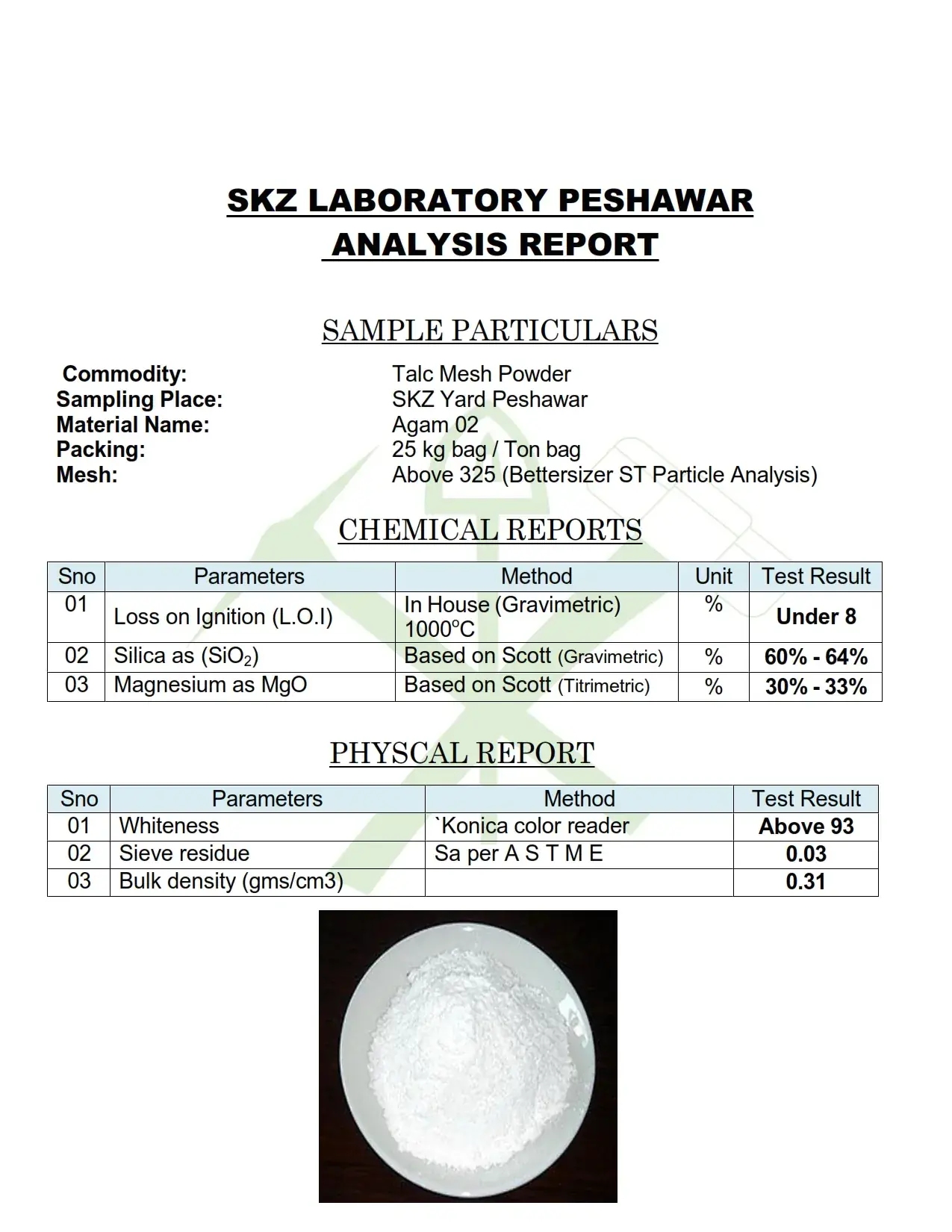
Talc mesh powder — sample “Agam 02”

Commodity
Talc mesh powder
Sampling place
SKZ Yard, Peshawar
Fineness
Above 325 mesh (Bettersizer ST particle analysis)
Packing
25 kg bag / ton bag
Chemical analysis
ParameterMethodUnitResult
Loss on ignition (LOI)In-house gravimetric, 1000 °C%Under 8
Silica as SiO₂Based on Scott (gravimetric)%60 – 64
Magnesium as MgOBased on Scott (titrimetric)%30 – 33
Physical analysis
ParameterMethodUnitResult
WhitenessKonica colour reader—Above 93
Sieve residueAs per ASTM E—0.03
Bulk density—g/cm³0.31
Scanned SKZ Laboratory Peshawar analysis report for a talc mesh powder sample.

Scan of the original report. The table on the left is a transcription of it.
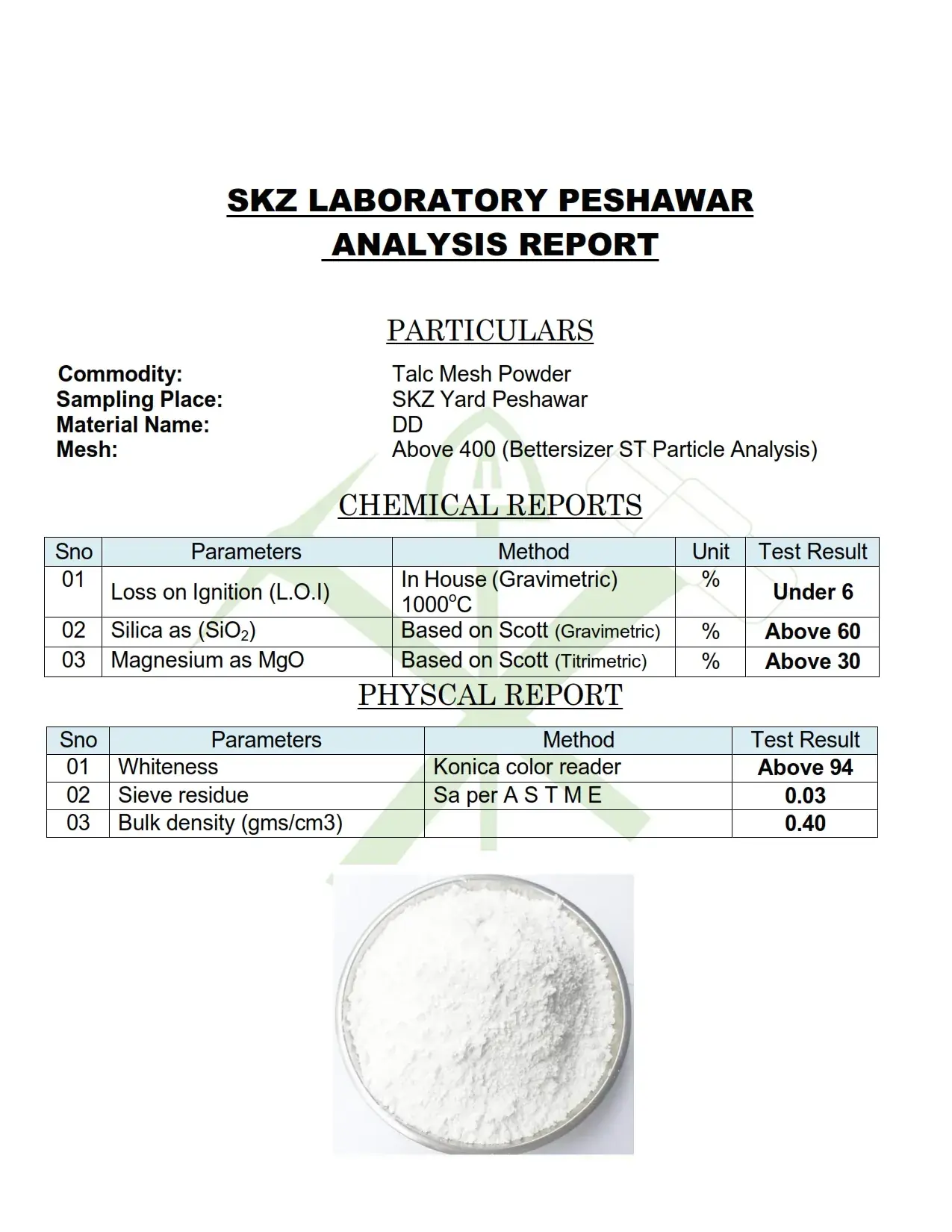
Talc mesh powder — sample “DD”

Commodity
Talc mesh powder
Sampling place
SKZ Yard, Peshawar
Fineness
Above 400 mesh (Bettersizer ST particle analysis)
Chemical analysis
ParameterMethodUnitResult
Loss on ignition (LOI)In-house gravimetric, 1000 °C%Under 6
Silica as SiO₂Based on Scott (gravimetric)%Above 60
Magnesium as MgOBased on Scott (titrimetric)%Above 30
Physical analysis
ParameterMethodUnitResult
WhitenessKonica colour reader—Above 94
Sieve residueAs per ASTM E—0.03
Bulk density—g/cm³0.40
Scanned SKZ Laboratory Peshawar analysis report for a talc powder sample above 400 mesh.

Scan of the original report. The table on the left is a transcription of it.

SKZ Laboratory Peshawar

In the laboratory

Technicians prepare and dry samples, then run particle-size, colour and chemical analyses. If you need independent third-party inspection, mention it when you send your enquiry.

Laboratory technician placing samples into a drying oven.
Sample preparation in the laboratory.
Two inspectors in uniforms and caps checking white talc lumps with a worker during hand sorting.
Inspectors checking lumps during hand sorting.
Laboratory bench with drying ovens and staff at work.
Laboratory bench with drying ovens.

Questions

Quality questions buyers ask

What PakTalc measures, and what the published results mean.

How is PakTalc's talc tested?

SKZ Laboratory Peshawar tests powder samples for particle size by laser analysis (Bettersizer ST), whiteness by colour reader (Konica), sieve residue, bulk density, loss on ignition at 1000 °C, silica (SiO₂) and magnesia (MgO). The full method and two published sample results are on the quality-control page.

What is the whiteness of PakTalc's talc powder?

Two SKZ Laboratory Peshawar sample reports are published. The above-325-mesh sample (Agam 02) shows whiteness above 93; the above-400-mesh sample (DD) shows whiteness above 94. These are individual sample results, not a guaranteed specification for every lot. Ask for a lot analysis with your quotation.

What is loss on ignition (LOI) in talc?

Loss on ignition is the weight lost when a sample is heated to 1000 °C. It indicates carbonate and other associated minerals. A lower LOI is closer to pure talc. The published Agam 02 report shows LOI under 8 % and the DD report shows LOI under 6 %.

Can I request a Certificate of Analysis (COA) or lot-specific analysis?

Yes. Ask for a lot analysis with your quotation by mentioning it in your enquiry. The published sample reports on the quality control page show the kind of analysis SKZ Laboratory Peshawar provides; they are not a guaranteed specification for every lot.

Does PakTalc hold ISO certification?

No ISO certification is claimed on this website. Buyers requiring specific quality management certification should ask directly so that the current documentation can be shared.

Enquiries

Need a lot-specific analysis?

Ask for a sample and analysis with your quotation. Tell us which parameters and limits matter for your application.